
About my Thesis
The title of my bachelor thesis was "Adaptively measuring quantum expectation values using the empirical Bernstein stopping rule".We looked at an application of the empirical Bernstein stopping rule[1] (EBS) in the context of quantum computing, referring to the footnote below for the orginial paper.
$$|\overline{X}_{t}-\mu| \leq \overline{\sigma}_t\sqrt{\frac{2\ln{(3/\delta)}}{t}}+\frac{3R\ln{(3/\delta)}}{t}.$$ Where $\overline{X}_t$ is the empirical mean, $\mu$ is the true mean, $\overline{\sigma}_t$ is the empirical standard deviation, $R$ is the range of the random variable, $t$ is the number of samples taken and $\delta$ is the confidence parameter.
The goal was to explore a new method to estimate quantum expectation values with a requireyd accuracy $\epsilon$ and confidence of $1 - \delta$ while minimizing the amount of shots needed.
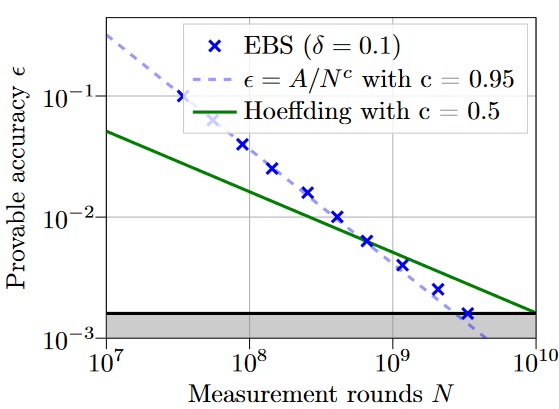
In the below figure we see the EBS algorithm compared against Höffdings inequality, in the context of measuring the ground state energy of NH3.
We set the accuracy $\epsilon$ to the chemical accuracy, i.e. 0.0016 Hartee. This accuracy is choosen such that subsequent calculations
still yield realistic chemical accuracies. Here EBS outpeforms, i.e., requires less samples for an estimate than Höffdings.
[1] Mnih et al., 2008